
How to remove plastic from your daily cuppa - simple habits for tea and coffee making
If you drink tea or coffee every day (like most of us), you’re probably using more plastic than you realise. From pod machines to kettles and even “glass” coffee makers with hidden plastic parts — hot water and plastic often go hand in hand. And that’s exactly the problem
When plastic is exposed to heat, it can release chemicals and microplastics into your drink. So it’s likely your daily cuppa has more than just caffeine.
Switching to a plastic-free tea and coffee setup is surprisingly easy — and often makes your drinks taste better too.
Why do we need to go plastic free?
Here’s a quick reminder why some people are making the switch:
Reduce exposure to microplastics
Improve taste (no “plastic” flavour)
Cut down waste (especially pods and capsules)
Use longer-lasting, durable materials like glass and stainless steel.
Swaps you can make today
1. Ditch the coffee pod machines
Yep - this one was tough for us. Just loved our Aldi coffee machine and pods. They were a low cost per pod and so convenient and quick. But yikes, we were literally pouring plastic into every cup. Hot water and plastics do not mix well.
Pod machines (like Nespresso-style systems):
Use single-use plastic or aluminium pods
Often contain internal plastic components exposed to heat
Create ongoing waste and cost.
If you want a low-waste, plastic-free morning cuppa, this is the first thing to replace.
2. Switch to a french press (Cafetiere)
Swapping from a pod machine to a french press is an easy upgrade. The coffee does not take long to make, there are minimal parts, much less waste, and a great flavour.
Opt for a press with glass and/or stainless steel. Check the product details carefully though, most glass coffee plungers have plastic filters or plungers. We actually picked up a Bodum and a small steel cafetiere at my local Op shop for $5, so start there if the budget is tight.
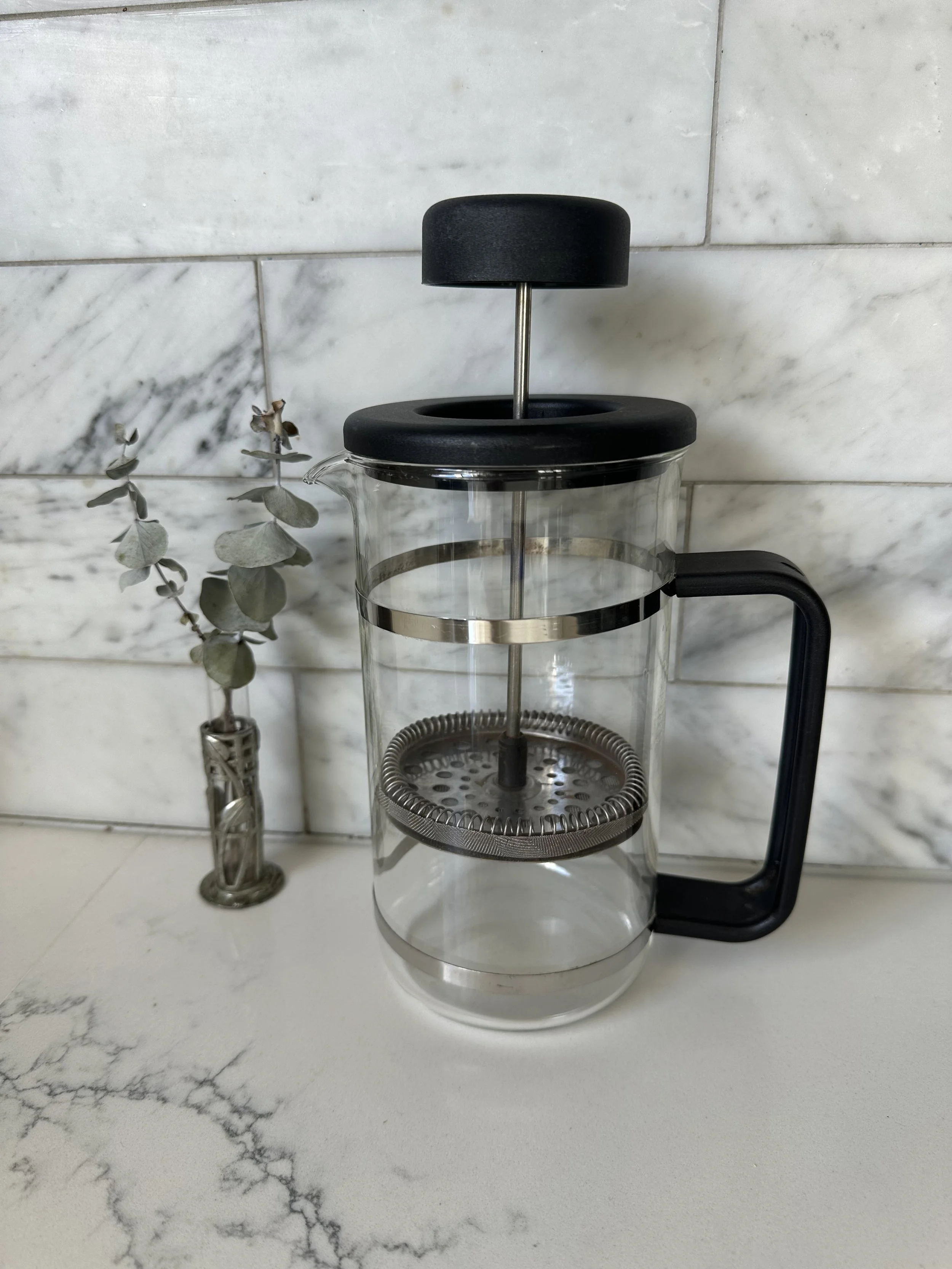
The cafetiere in the picture is a Bodum one we picked up at our local charity shop.
One&One Stainless Steel Coffee Plunger
Made from top quality 18/10 stainless steel, both the interior and exterior, and the plunger. It has double wall insulation to keep warm for longer.
Available in various sizes from 1 cup (350ml) to 6 cup (1 litre).
It is insulated and shatterproof and dishwasher safe.
Easyworkz Porcelain French Press
Made from top quality white ceramic and polished stainless steel for a vintage style.
Would look very stylish sitting on a kitchen bench, so a higher price point.
Uses the authentic French press method to fully unlock the rich oils and robust flavours from your favourite ground coffee.
Available in 650ml and 1 litres sizes.
3. Ditch the teabags and go back to loose leaf tea
We know that T2 and other retailers have been selling loose leaf tea alongside tea bags for some time. There’s a reason why they are so popular. Did you know that many tea bags contain plastic? It’s in the bag coating. Whilst many tea companies are swapping them out, there are still plenty in Australia making tea bags that contain plastic, and can’t be composted.
Swapping to loose leaf and getting a traditional teapot has many benefits.
A good plastic-free teapot uses borosilicate glass (heat resistant), or is ceramic. Many tea infusers are stainless steel, so there is zero plastic in contact with water.
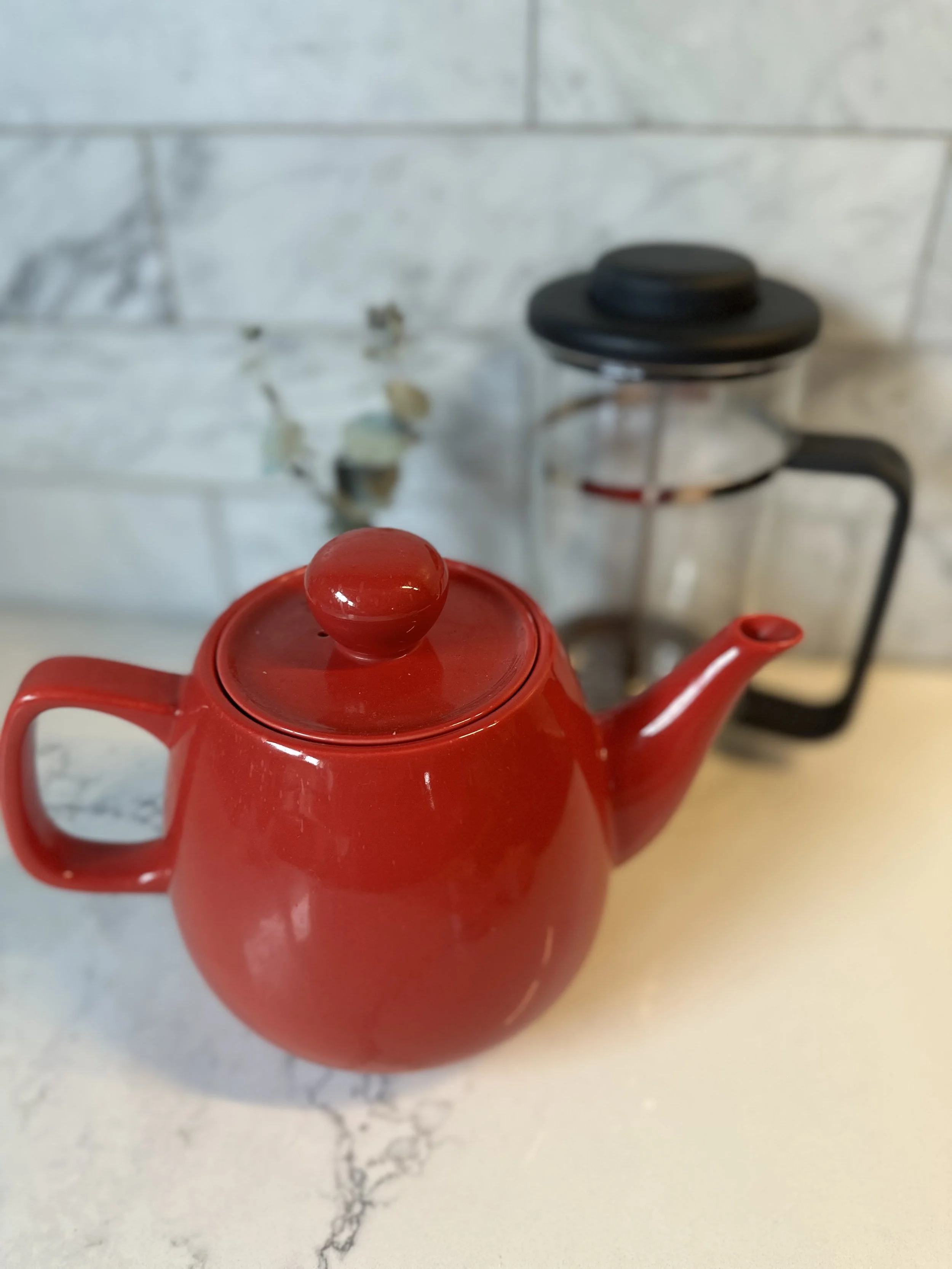
The red teapot in this photo is one from T2 which we picked up from an Op Shop for $10.
Hiware Glass Teapot with stainless steel lid and infuser
So many teapots contain plastic in the lid or filter.
We picked this option as its made out of heat resistance borosilicate glass and has a stainless steel removable infuser. With the added benefit that you can pop it straight on your stove and heat water within it, removing the use of a kettle if you wanted to.
The metal parts are made out of 304 stainless steel, including the lid, the infuser filter and the holder of infuser. The fine mesh infuser is perfect for loose teas. It is also microwave safe and dishwasher safe!
Maxwell & Williams Teas & C's Silk Road
Tea for One with Infuser
We wanted to include a pot for one option, including a tea cup, and this version features an Australian design by Gabby Malpas. Comes in a gift box, would make a great gift for someone with a home office or who enjoys quality tea.
Made from porcelain with stainless-steel infuser. This version has real gold detail - so can’t go in the microwave or dishwasher - just FYI.
Includes tea for one with infuser and 380ML capacity in aqua colour.
Disclaimer: As an Amazon Associate, we earn from qualifying purchases.
To help us with the cost of setting up and running this website, we are adding direct purchase links to recommended products.
Then we may take a small commission from the businesses, if you choose to buy from them. Thanks for your support!
4. Try drip pour coffee
Pour-over is one of the cleanest, most minimalist ways to make coffee.
It’s very low waste and you get full control over the flavour. You can even put coffee grounds into your composter or food waste bin, if you have one.
You only need:
A dripper (glass, ceramic, or stainless steel)
A filter (paper or metal)
Fresh ground coffee.
Unbreakable Glass Carafe Pour Over Coffee Maker
Feel like a Melbourne hipster barista with this set! Both the dripper and the coffee pot are made of borosilicate glass, and included filter paper is made from natural wood pulp without any bleaching.
The capacity is 20 ounces/600ml which is for 1-3 people. The included lid makes it easy to keep coffee cold in the refrigerator.
Equipped with 100 sheets of disposable filter paper, which is made of pure wood pulp, no odour, unbleached. The Borosilicate glass dripper has a walnut handle, which can be placed over a cup or glass as well.
Swaps you can make today
5. Check your kettle
This one surprises people. Many kettles have plastic interiors or spouts, so they expose water to plastic when boiling.
If you want to go fully plastic-free choose stainless steel or glass kettles and avoid plastic water windows or lids where possible.
What most people don’t realise
Even products marketed as “glass” or “premium” often still include:
Plastic filter holders
Plastic lids
Internal tubing
If you want to go fully plastic-free, check every part that touches hot water.
Going plastic-free with tea and coffee doesn’t mean giving up convenience — it just means simplifying your setup.
In fact, many people find:
Their coffee tastes better
Their routine feels more mindful
They spend less over time.
And best of all — you’re cutting down potential plastic exposure every single day.
Hazel Quinn Electric Vintage Kettle
We found a kettle that has minimal plastic parts - not easy!
This retro electric kettle is crafted with food-grade 304 stainless steel in its interior, lid, and filter. It has no plastic in contact with the water.
This powerful 2200 Watt tea kettle can quickly boil 1.7 litres of water in 4 to 5 minutes. It has a thermometer dial so you can ensure your desired temperature, for different teas/ hot drinks or cooking methods.
Written September 2026
Research commissioned by the WWF and the Plastic Free Foundation shows that 85% of Australians want to reduce their use of disposable plastics.
Ready to take the next step and buy some new items?
Look at our other product examples and blogs for inspiration.
We want to be transparent about where our facts and data have come from. In a world of ‘fake news’ and AI, its good to be clear about information, so that you can trust it.
Tea bags leaching chemicals - a 2019 McGill University study, published in the journal Environmental Science & Technology. Researchers steeped emptied plastic tea bags in water heated to 95°C for five minutes and found a single bag released approximately 11.6 billion microplastics and 3.1 billion nanoplastics into one cup. Heat clearly drove this. The bags still released high levels of plastic at room temperature, but about 300 times less than at brewing temperature.
CTV News summary of the McGill study: https://www.ctvnews.ca/health/microplastics-in-your-tea-study-finds-billions-in-a-bag-brewed-cup-1.4609715
Discover Magazine: https://www.discovermagazine.com/health/plastic-tea-bags-release-billions-of-microplastics-into-every-cup
Microplastics in pod machines - TIME: https://time.com/7331064/coffee-pods-plastic/ and also https://freshcup.com/new-research-shows-coffee-pods-may-release-microplastics-into-your-cup/
Tea bags containing plastic in Australia - CHOICE tea bag buying guide: https://www.choice.com.au/food-and-drink/drinks/tea-and-coffee/buying-guides/tea-bags and comparison table (compostability by brand): https://www.choice.com.au/compareproducts/food-and-drink/drinks/tea-bags